
Ajit Mishra, vice president, Research, Religare Broking, answers your queries

Ajit Mishra, vice president, Research, Religare Broking, answers your queries.

As yields on 10-year government bonds rose from 6.65% in April 2017 to around 7.50% now, liquidity pressures have increased the cost of funds for housing finance companies.

RBI projects GDP growth in FY16 at 7.8 per cent, 30 bps higher than FY15. However, this comes with a downward bias.
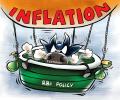
Inflation in food articles basket was 6.99 per cent In May, 2019, down from 7.37 per cent in April. However, onion prices spiked in May with inflation at 15.89 per cent, as against (-) 3.43 per cent in April.

The S&P BSE Sensex surged 364 points to end at 24,607 and the Nifty50 soared 107 points to close at 7,476.

Ajit Mishra, vice president, Research, Religare Broking, answers your queries.

Gaurav Garg, Head of Research, CapitalVia answers readers' stock market queries.

While the COVID-19 pandemic has completely halted production and new orders, exporters say that payments have also been delayed for the shipments sent before the lockdown. Exporters say some customers are not taking delivery of the shipments because they have shut shop. Ready-made garment players had been hoping for a revival in demand in China but with the virus spreading to Europe, the US and other major markets, there are no orders coming from the major retailers.

Outflows are likely to continue, experts say, till such time as the markets see a significant correction.

Bucking the overall downtrend, shares of RIL rallied nearly 10 per cent, capping the Sensex loss to a large extent.
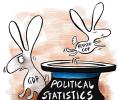
India Ratings and Research on Friday revised down India's FY22 real GDP growth forecast to 10.1 per cent, from earlier projection of 10.4 per cent, citing the second wave of COVID-19 infections and slower pace of vaccination. At a time when large parts of the country are experiencing tremendous pressure on medical infrastructure, the agency said it expects the second wave to start subsiding by mid-May. Earlier this month, the Reserve Bank maintained its 10.5 per cent GDP growth estimate, but Governor Shaktikanta Das has flagged the rising cases as the biggest impediment to recovery.


Experts say the stock market correction in recent times increases the risk-reward in favour of large-cap stocks.

Three stockmarket experts give their best picks for the New Year.
Market players said a big upmove by the market will depend on policy action by the government to revive economic growth and corporate earnings revival.

December 2022 could be the last Christmas for Santha Bakery, a business drawing its lineage from the first Christmas cake baked in Kerala.

The relentless rally in small- and mid-cap stocks continues as large-caps show signs of fatigue. In July, the Nifty Smallcap 100 rose 8.1 per cent, extending its year-to-date (YTD) gains to 48.5 per cent, while the Nifty Midcap 100 added 3.1 per cent, taking its YTD rise to 33.5 per cent. On the other hand, the Nifty50 remained unchanged for the month, with YTD gains of 12.7 per cent.

As India emerges from the COVID-19 crisis, the ninth budget under the Modi government, including an interim one, is widely expected to focus on boosting spending on job creation and rural development, generous allocations for development schemes, putting more money in the hands of the average taxpayer and easing rules to attract foreign investments.

After a delayed start, the monsoon is advancing steadily.
Ajit Mishra, vice president, Research, Religare Broking, answers your queries.
Ajit Mishra, vice president, Research, Religare Broking, answers your queries.

TCS plans to build ignio as a standalone company.

Persistent capital inflows by domestic institutional investors and retail investors kept the markets in fine nick

Private equity players said their research had shown that the PE share after COVID-19 could go up to 8-10 per cent.

Pragmatism and flexibility is a virtue. An untethered and short-term approach to policymaking is a flaw, argues Mihir S Sharma.

'The market won't wait for earnings to recover.'

'Do some profit booking and bring your equity allocation back to its original level.'

If Sachin Bansal sells his stake at a little over 5 per cent and steps down from Flipkart, as reports have suggested recently, either Binny Bansal or Kalyan Krishnamurthy, CEO of Flipkart, could be an option for the leadership position.

Flipkart will need $2 bn annual profit to make Walmart investment viable, which will mean yearly revenue of $100 bn

The FPI holding in India's top 100 companies, which are part of the Nifty 100 index, declined to 24.23 per cent on average at the end of March this year, from a high of 27.5 per cent at the end of March 2021. This is the lowest FPI holdings in India's top listed companies in at least three years. A general sell-off by FPIs has weighed on stock prices and the benchmark S&P BSE Sensex is down 8.5 per cent, from its 52-week high made in October 2021. Most analysts expect FPI flows to remain weak in FY23 as well, given rising bond yields in the US and an expected earnings slowdown in India due to high inflation and commodity prices.

In the 52 newly listed companies since 2014, fund managers have a total investment of a mere 2.5 per cent of their assets under management.
RBI Governor Raghuram Rajan in his maiden policy review, however, eased liquidity though a reduction in the marginal standing facility rate, at which banks borrow from the central bank, by 0.75 per cent to 9.5 per cent.

Ajit Mishra, vice president, Research, Religare Broking, answers your queries.
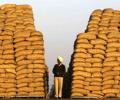
The central bank has lowered its policy rate twice so far in 2015.

Ajit Mishra, vice president, Research, Religare Broking, answers your queries:

Gautam Adani, who is diversifying into many businesses, saw a 48 per cent rise in his wealth to Rs 1.40 lakh crore and moved up two places in rankings to being the fourth richest Indian. Hinduja Brothers and HCL's Shiv Nadar were ranked 2nd and 3rd. Wipro's Azim Premji slipped two places to fifth place.
Revenue up 15.8% at Rs 34,261 crore over year-ago period.

Corporate indebtedness is now twice what it was before the global financial crisis; banks' bad loans ratio is 3.5 times higher.

The government kept its nerve in the face of a massive shock. It chose not to resort to a massive fiscal stimulus. It focused instead on providing liquidity support and easing restrictions on movement in stages, observes T T Ram Mohan.
 © 2026 Rediff.com - Advertise with us - Disclaimer - Privacy Policy - Sitemap - Feedback - About us - Terms of use - Grievances